
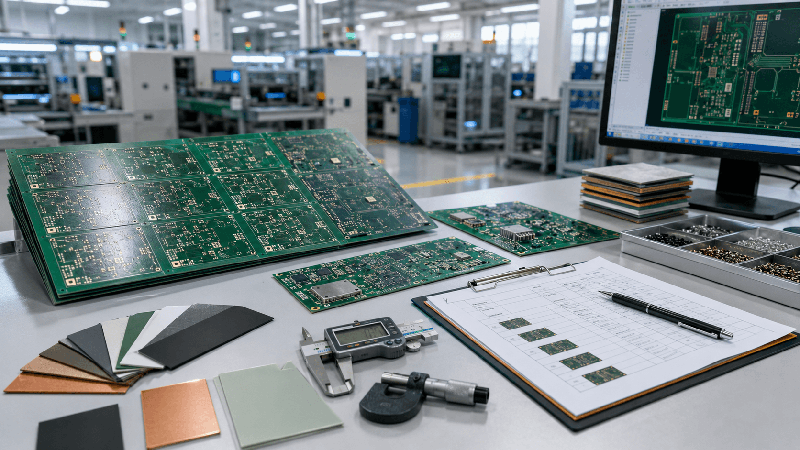
PCB manufacturing cost is affected by many design and production choices. Two circuit boards may look similar, but their prices can be very different if the layer count, material, copper thickness, tolerances, surface finish, quantity, or delivery time are different.
Understanding the main PCB manufacturing cost factors helps engineers and buyers make better decisions before sending files for quotation. EazyPCB supports PCB fabrication for prototypes and production, and you can also use the PCB price calculator for quick project estimation.
1. Layer Count
Layer count is one of the most important PCB manufacturing cost factors. A 2-layer PCB is usually much cheaper than a 4-layer, 6-layer, or 8-layer PCB because multilayer boards require more materials, lamination steps, inspection, and process control.
More layers can improve routing density, signal integrity, power distribution, and EMI performance, but they also increase manufacturing complexity. The right layer count should be chosen based on circuit requirements, not only price.
2. Board Size and Panel Utilization
Larger boards use more material and reduce the number of boards that fit on a production panel. Irregular shapes, many cutouts, slots, and complex outlines can also affect panel utilization and routing time.
Good panelization can improve manufacturing efficiency, especially for small boards and volume production. If your design will go through assembly, panel size, tooling rails, fiducials, and depanelization method should be considered early.
3. Material Selection
Standard FR-4 is cost-effective for many PCB manufacturing projects. However, high-TG FR-4, aluminum substrate, Rogers, PTFE, ceramic, or other special materials can increase cost because of material price, process requirements, and availability.
For more detail, see our PCB material selection guide. Choosing the correct material early helps avoid cost surprises later.
4. Copper Thickness
Copper thickness affects current capacity, heat dissipation, etching process, and final PCB price. Standard 1 oz copper is suitable for many boards, while 2 oz copper or heavy copper is often used for power electronics, motor control, LED products, and high-current designs.
Thicker copper can improve electrical and thermal performance, but it may require wider trace and spacing rules. Our PCB copper thickness guide explains how copper weight affects manufacturability and cost.
5. Minimum Trace, Spacing, and Hole Size
Very fine traces, tight spacing, small holes, microvias, blind vias, buried vias, and via-in-pad structures usually increase PCB manufacturing cost. These features require more advanced equipment, tighter process control, and more inspection.
If your design is near process limits, review the PCB manufacturing capabilities before production. Designing within standard capability is usually more economical and reliable.
6. Surface Finish
Surface finish protects exposed copper and supports solderability. HASL, lead-free HASL, OSP, ENIG, immersion silver, and immersion tin all have different cost, shelf life, flatness, and soldering characteristics.
ENIG is often selected for fine-pitch components, BGA, and better surface flatness, but it usually costs more than HASL or OSP. Our PCB surface finish guide compares common options.
7. Manufacturing Tolerances
Tighter tolerances can increase cost because they require more precise process control and inspection. Board thickness, finished hole size, outline dimensions, copper width, solder mask registration, and impedance tolerance should be defined carefully.
Not every dimension needs to be extremely tight. The best approach is to mark only the truly critical features. For more detail, review our PCB manufacturing tolerances guide.
8. Quantity and Lead Time
Prototype PCB manufacturing usually has a higher unit cost because setup, engineering review, CAM work, and production preparation are spread across a small quantity. As quantity increases, the unit cost usually decreases.
Lead time also matters. Urgent orders may require priority production, faster material preparation, and extra scheduling effort. If cost is more important than speed, standard lead time is usually more economical.
9. Testing, Inspection, and Quality Requirements
Electrical testing, visual inspection, dimensional checks, impedance testing, microsection analysis, and special quality documentation can affect cost. These steps are valuable when product reliability or customer requirements are strict.
Quality expectations in PCB manufacturing are often aligned with IPC standards. For supplier quality systems, ISO 9001:2015 is also a common reference.
10. Assembly Requirements
If the project includes components, PCB manufacturing cost should be considered together with SMT assembly. Surface finish, panelization, fiducials, solder mask design, stencil requirements, BOM quality, and testing plan all affect total project cost.
A low PCB price is not always the lowest total cost if the board creates assembly problems. For PCBA projects, fabrication and assembly should be reviewed together.
How to Reduce PCB Manufacturing Cost
- Use standard materials when the application allows.
- Keep layer count as low as the design reasonably permits.
- Avoid unnecessarily tight trace, spacing, hole, and outline tolerances.
- Choose surface finish based on real assembly and reliability needs.
- Plan panelization early for small boards and SMT assembly.
- Provide complete Gerber, drill, stack-up, and fabrication notes.
- Discuss special requirements before production starts.
Get a Clear PCB Manufacturing Quote
A good PCB quote depends on clear data. Layer count, material, board size, quantity, copper thickness, surface finish, tolerances, testing, and delivery time should be confirmed before production.
EazyPCB supports prototype and production PCB manufacturing with engineering review and quality control. If you want to optimize price without creating manufacturing risk, you can contact our team with your Gerber files and project requirements.
