
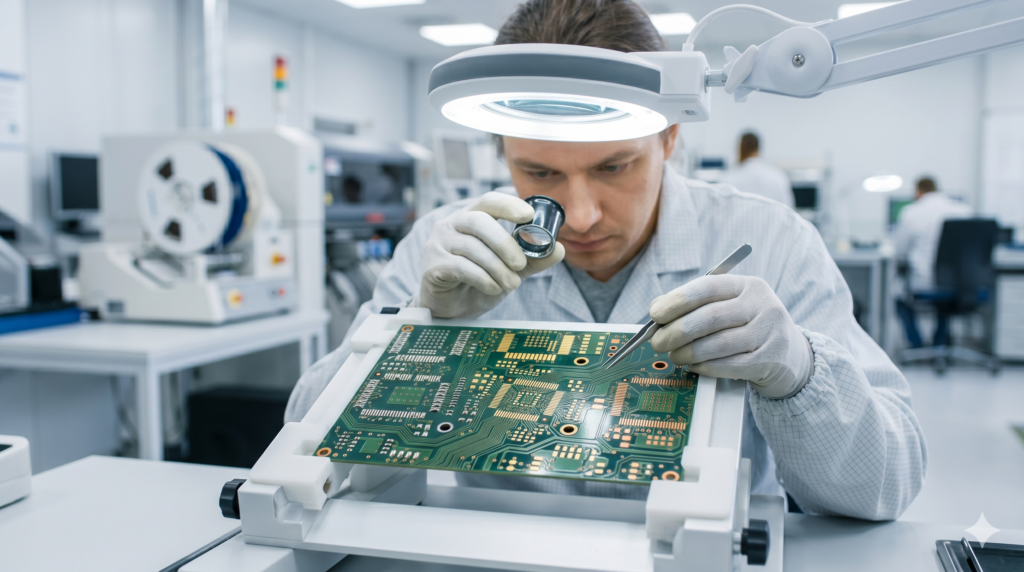
The PCB surface finish protects exposed copper pads from oxidation and creates a solderable surface for assembly. Choosing the right finish affects solderability, cost, shelf life, flatness, reliability, and compatibility with your components.
For many designs, the surface finish may look like a small detail. In reality, it can influence assembly yield and long-term product performance, especially for fine-pitch components, lead-free soldering, high-reliability electronics, and products stored for a long time before assembly.
Why PCB Surface Finish Matters
After PCB fabrication, copper pads cannot be left exposed for long. Copper oxidizes quickly, and oxidized pads are difficult to solder. A surface finish acts as a protective and solderable layer between fabrication and assembly.
The best choice depends on your assembly process, component package type, budget, storage time, and reliability expectations. There is no single finish that is perfect for every board.
HASL: Cost-Effective and Common
HASL, or hot air solder leveling, is one of the most common and economical PCB surface finishes. The board is coated with solder and leveled with hot air. Lead-free HASL is widely used for general electronics where cost is important.
HASL has good solderability and reasonable shelf life, but its surface is not as flat as some other finishes. For very fine-pitch components, BGA packages, or high-density designs, this lack of flatness can become a limitation.
ENIG: Flat, Reliable, and Popular for Fine-Pitch Designs
ENIG stands for electroless nickel immersion gold. It creates a flat surface with a nickel barrier layer and a thin gold layer on top. ENIG is widely used for boards with fine-pitch components, BGAs, connectors, and applications that require good shelf life.
Compared with HASL, ENIG is more expensive, but it provides excellent surface planarity and stable solderability. It is often a strong choice for high-density, professional, and export-oriented electronics products.
OSP: Simple and Economical
OSP, or organic solderability preservative, is a thin organic coating that protects copper before soldering. It is low cost, lead-free, and creates a very flat surface.
However, OSP is more sensitive to handling and storage conditions. It is often suitable for high-volume products with a controlled assembly schedule, but it may not be ideal if boards will be stored for a long time or go through multiple thermal cycles.
Immersion Silver and Immersion Tin
Immersion silver provides a flat surface and good solderability, making it useful for some high-frequency and lead-free applications. It must be stored carefully because silver can tarnish when exposed to certain environments.
Immersion tin is another flat, lead-free finish. It can be suitable for press-fit and some fine-pitch applications, but storage time and handling conditions must be controlled to avoid solderability issues.
How to Choose the Best Finish
- Choose HASL or lead-free HASL when cost is the main priority and the design does not use very fine-pitch components.
- Choose ENIG for fine-pitch parts, BGA components, good shelf life, and a premium flat surface.
- Choose OSP for cost-sensitive, high-volume production with fast and controlled assembly.
- Consider immersion silver for applications that need flatness and good electrical performance.
- Confirm finish compatibility with your assembly process, soldering profile, and storage conditions.
Discuss Surface Finish Before Production
If your PCB includes fine-pitch ICs, BGA packages, high-current pads, connectors, or strict reliability requirements, surface finish should be selected before the design is finalized. Changing it late may affect cost, lead time, and assembly results.
EazyPCB supports multiple PCB surface finishes for prototype and production orders, including HASL, lead-free HASL, ENIG, OSP, immersion silver, and immersion tin. If you are not sure which option is best for your project, our team can help you choose a finish that balances cost, reliability, and assembly performance.
