
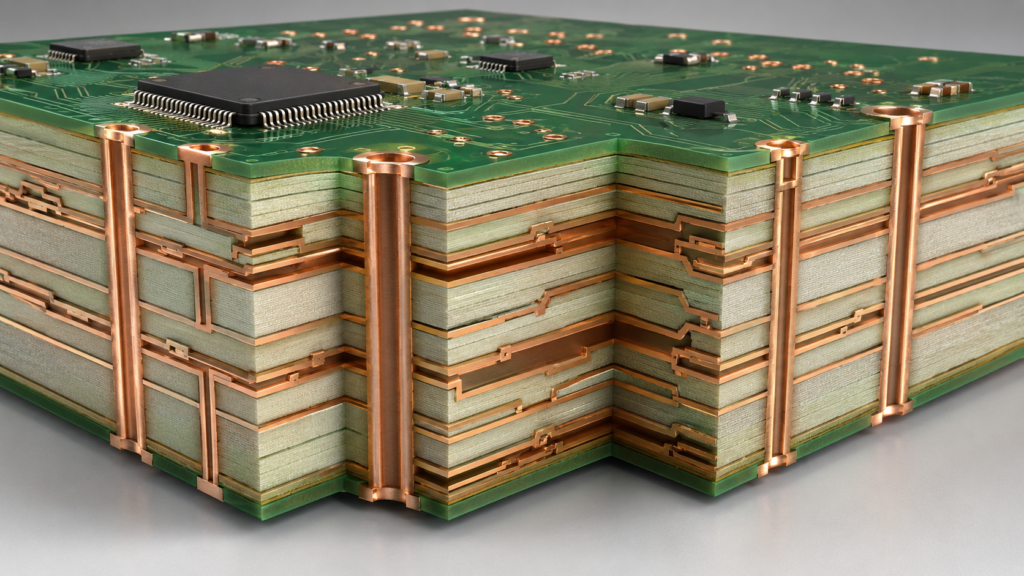
Choosing the right PCB layer count is one of the earliest and most important decisions in a board design. A 2-layer PCB may be simple and cost-effective, while a 4-layer or multilayer PCB can provide better routing, signal integrity, EMI control, and power distribution.
The best choice depends on the circuit complexity, product size, electrical performance, budget, and reliability requirements. Selecting too few layers can make routing difficult and create performance issues. Selecting too many layers may increase cost without adding real value.
What Is a 2-Layer PCB?
A 2-layer PCB has copper on the top and bottom sides of the board. Components and traces can be placed on both sides, and plated through holes or vias connect the two copper layers.
2-layer PCBs are commonly used for simple electronics, power supplies, LED boards, basic control circuits, hobby products, and cost-sensitive designs. They are usually easier to manufacture and more economical than boards with more layers.
When a 2-Layer PCB Is a Good Choice
- The circuit is relatively simple and has low routing density.
- The board size is not extremely compact.
- High-speed signal integrity is not a major concern.
- EMI requirements are not very strict.
- Cost is a primary design factor.
However, 2-layer boards can become difficult when the design has many ICs, dense connectors, fine-pitch packages, mixed-signal circuits, or strict noise requirements.
What Is a 4-Layer PCB?
A 4-layer PCB typically includes two outer signal layers and two internal layers used for power and ground. A common stack-up is signal, ground, power, and signal. This structure improves routing flexibility and creates better return paths for signals.
Compared with 2-layer boards, 4-layer PCBs can help reduce electromagnetic interference, improve signal integrity, and make power distribution cleaner. They are widely used in consumer electronics, IoT devices, communication modules, embedded systems, and industrial controllers.
When to Move from 2 Layers to 4 Layers
Moving to 4 layers is often a smart decision when the board is compact, the circuit has many connections, or the design includes high-speed signals. The extra layers may increase fabrication cost, but they can reduce layout risk and improve product stability.
If you spend too much time trying to route a dense 2-layer board, or if the ground path becomes fragmented, a 4-layer design may be more reliable and efficient.
What Is a Multilayer PCB?
A multilayer PCB usually refers to boards with more than 4 layers, such as 6-layer, 8-layer, 10-layer, or higher layer counts. These boards are used when routing density, signal integrity, power distribution, or product size requires additional internal layers.
Multilayer PCBs are common in high-speed electronics, medical devices, automotive electronics, aerospace products, networking equipment, advanced industrial systems, and compact consumer devices.
Key Factors When Choosing Layer Count
- Routing density: More components and fine-pitch packages usually need more layers.
- Signal integrity: High-speed signals benefit from controlled impedance and solid reference planes.
- EMI control: Ground planes and proper stack-up help reduce noise and emissions.
- Power distribution: Internal power and ground planes can improve current delivery and reduce voltage drop.
- Board size: Smaller boards often require more layers to complete routing.
- Cost: More layers increase manufacturing cost, so the design should justify the layer count.
Practical Selection Guide
Use a 2-layer PCB for simple, low-cost designs where routing and EMI are manageable. Use a 4-layer PCB when the design needs better grounding, cleaner power distribution, higher density, or improved signal performance. Use a multilayer PCB when the product requires compact size, high-speed routing, controlled impedance, or advanced reliability.
The correct layer count is not only a cost decision. It affects layout quality, manufacturing yield, product stability, and long-term reliability.
Work with Your PCB Manufacturer Early
If your design involves high-speed signals, impedance control, heavy current, dense BGAs, or strict EMI requirements, it is worth discussing the stack-up before finalizing the layout. Early stack-up planning can reduce redesign work and help the board move smoothly into production.
EazyPCB supports 2-layer, 4-layer, and multilayer PCB manufacturing for prototypes and production runs. If you are not sure which layer count is right for your project, our team can help review your design requirements and recommend a practical stack-up option.
