
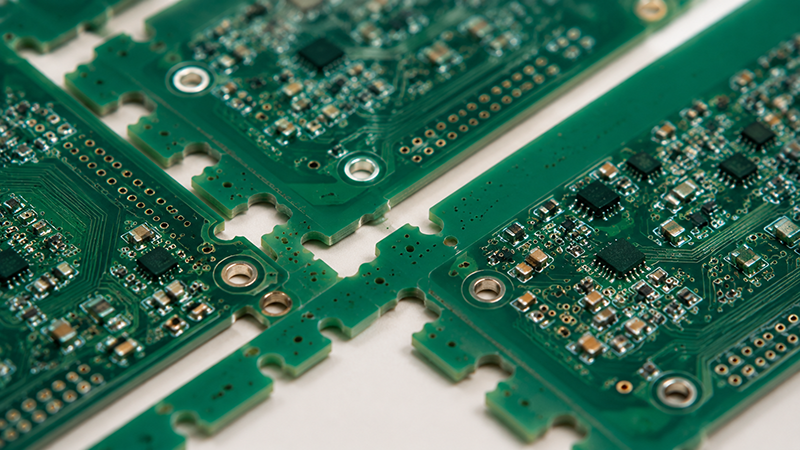
PCB panelization is the process of arranging multiple circuit boards into one manufacturing panel. Instead of producing and assembling each small board individually, several boards are processed together as a single array.
Good panelization improves production efficiency, reduces handling problems, supports SMT assembly, and protects small or irregularly shaped boards during fabrication. Poor panel design can cause assembly issues, broken edges, depanelization damage, or extra manufacturing questions.
Why PCB Panelization Matters
Small PCBs can be difficult to handle during solder paste printing, pick-and-place, reflow soldering, inspection, and testing. A panel provides a stable format for machines and operators.
Panelization is especially important for small boards, thin boards, irregular shapes, boards with edge components, and production runs that require automated SMT assembly.
V-Score Panelization
V-score, also called V-cut, creates shallow grooves along straight separation lines between boards. After assembly, the boards can be separated along the scored lines.
V-score is efficient and cost-effective for rectangular boards with straight edges. However, it is not suitable for curved outlines or complex shapes. Designers should keep sensitive components and copper features away from the V-score line to reduce stress during separation.
Tab Routing and Mouse Bites
Tab routing uses routed slots around the board outline while leaving small tabs to hold each board in the panel. Mouse bites are rows of small holes in the tabs that make separation easier.
This method is useful for irregular board shapes, round boards, and designs where V-score is not possible. It provides more outline flexibility but may leave small rough edges after depanelization.
Tooling Rails for SMT Assembly
Tooling rails are extra material added to the sides of a panel. They provide space for conveyor handling, clamps, fiducials, labels, and tooling holes during SMT assembly.
If components are too close to the board edge, tooling rails may be required so the panel can pass through assembly equipment safely. Rails are often removed after assembly.
Fiducials and Tooling Holes
Fiducials are reference marks used by pick-and-place machines and inspection systems for alignment. A panel usually needs global fiducials, and some designs may also use local fiducials near fine-pitch components.
Tooling holes help position the panel in fixtures or equipment. Their size and location should be confirmed with the assembly manufacturer, especially for production orders.
Common PCB Panelization Rules
- Keep components away from V-score lines and routed edges.
- Add tooling rails when boards are small or edge components are close to the panel boundary.
- Use V-score for straight rectangular boards when possible.
- Use tab routing and mouse bites for irregular shapes.
- Place fiducials clearly and keep them free from solder mask confusion.
- Confirm panel size with the manufacturer and SMT assembly process.
Panelization for Prototype vs Production
For prototypes, simple panelization may be enough, especially if boards are assembled manually or in small batches. For production, panel design should support automated solder paste printing, pick-and-place, reflow, AOI, testing, and depanelization.
Production panels should balance material usage, handling stability, assembly efficiency, and safe board separation.
Who Should Design the Panel?
Some customers provide their own panelized Gerber files. Others send single-board Gerbers and ask the PCB manufacturer to create the production panel. Both approaches can work, but the requirements must be clear.
If SMT assembly is included, the panel should be reviewed by the assembly team before production. This helps avoid problems with rail width, fiducial placement, board spacing, and component clearance.
Build Panels That Work in Production
Panelization is more than arranging boards in a grid. It connects fabrication, SMT assembly, handling, inspection, and final depanelization. A good panel design can make production smoother and reduce avoidable defects.
EazyPCB supports PCB fabrication and assembly for prototypes and production runs. If you are unsure whether your PCB should use V-score, mouse bites, tooling rails, or a custom panel layout, our team can help review the best panelization approach before production.
