
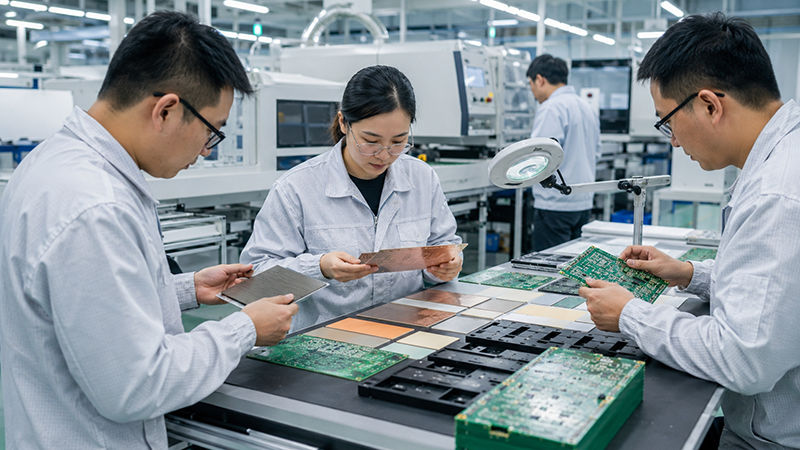
PCB material selection affects cost, electrical performance, thermal reliability, manufacturability, and product lifetime. For many standard electronics, FR-4 is enough. But for high-temperature, high-power, LED, RF, microwave, or high-speed applications, the material choice becomes much more important.
Choosing the right PCB material early helps avoid redesigns, production delays, and reliability issues. This guide explains common PCB materials and when each option makes sense.
FR-4: The Standard PCB Material
FR-4 is the most widely used PCB substrate. It is a glass-reinforced epoxy laminate with good mechanical strength, reasonable electrical properties, and cost-effective manufacturing. Most consumer electronics, industrial control boards, power supplies, and general digital circuits use FR-4.
FR-4 is usually the best starting point when the design does not have special thermal, RF, or high-speed requirements. It offers a strong balance of cost, availability, and manufacturing compatibility.
High-TG FR-4 for Higher Temperature Reliability
TG refers to glass transition temperature. When a PCB operates near or above the material’s TG, mechanical and electrical stability can be affected. High-TG FR-4 materials are designed to handle higher operating and assembly temperatures.
High-TG material is often used for automotive electronics, industrial products, high-layer-count boards, lead-free assembly, and products exposed to elevated temperatures. It can improve dimensional stability and long-term reliability.
Aluminum PCB for Heat Dissipation
Aluminum PCBs use a metal base to improve heat dissipation. They are common in LED lighting, power modules, motor drivers, and other applications where heat must be removed quickly from components.
Compared with standard FR-4, aluminum substrate boards provide better thermal transfer, but they usually have more limited layer structures and different manufacturing constraints. They are especially useful when thermal performance is the main design concern.
Rogers and High-Frequency Materials
Rogers materials and other high-frequency laminates are used for RF, microwave, antenna, radar, and high-speed communication applications. These materials offer more stable dielectric properties and lower signal loss than standard FR-4.
They are more expensive than FR-4, but they are often necessary when signal loss, impedance stability, or frequency performance is critical.
PTFE Materials
PTFE-based materials are used in demanding RF and microwave applications. They provide low dielectric loss and stable performance at high frequencies. However, PTFE materials can be more difficult to manufacture and may require special processing.
For advanced RF products, the material should be selected together with stack-up planning, impedance targets, copper roughness, and manufacturing capability.
Key Factors When Choosing PCB Material
- Operating temperature: Choose high-TG materials for high-temperature environments.
- Thermal performance: Use aluminum or metal-core PCB when heat dissipation is critical.
- Signal frequency: Use RF materials when high-frequency loss matters.
- Impedance control: Material dielectric constant affects controlled impedance traces.
- Mechanical requirements: Consider stiffness, thickness, vibration, and enclosure constraints.
- Cost and availability: Specialty materials increase price and may affect lead time.
Common Material Selection Examples
For a simple control board, standard FR-4 is usually suitable. For an automotive module or high-temperature industrial board, high-TG FR-4 may be a better choice. For LED lighting and power electronics, aluminum substrate can help manage heat. For RF antennas or microwave circuits, Rogers or PTFE materials may be required.
The best material is not always the most expensive one. It is the material that matches the product’s electrical, thermal, mechanical, and budget requirements.
Discuss Material Requirements Before Production
PCB material affects stack-up, trace width, impedance, thermal design, drilling, lamination, and cost. If your project involves high temperature, high power, RF signals, controlled impedance, or strict reliability requirements, material selection should be discussed before finalizing the layout.
EazyPCB supports PCB prototype and production manufacturing with a range of material options, including FR-4, high-TG FR-4, aluminum substrate, and high-frequency materials. If you are unsure which material is best for your project, our team can help review your application and recommend a practical option.
