
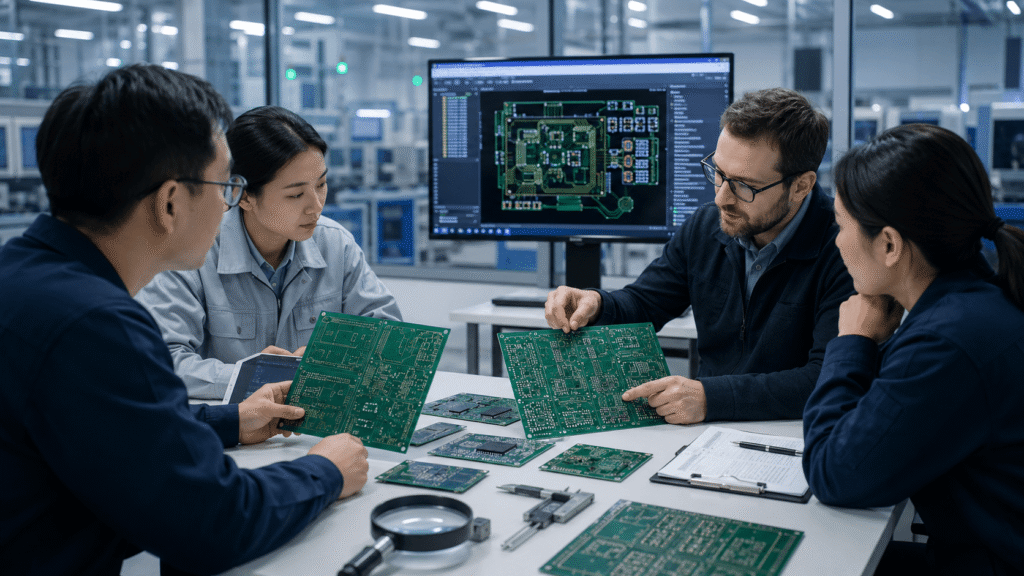
Choosing the right PCB manufacturing partner can affect product quality, development speed, cost control, and long-term supply stability. A PCB supplier should not only manufacture boards from Gerber files. The right partner should understand manufacturability, quality control, materials, tolerances, assembly requirements, and production communication.
For prototype and production projects, EazyPCB supports PCB manufacturing, engineering review, and assembly planning. Before choosing a supplier, it is worth checking several practical factors beyond the quoted price.
1. Manufacturing Capability
The first step is confirming whether the manufacturer can actually build your design reliably. Layer count, minimum trace and spacing, hole size, board thickness, copper thickness, surface finish, impedance control, HDI, rigid-flex, and special materials should all match the supplier’s capability.
Review the supplier’s PCB manufacturing capabilities before sending a complex order. A supplier may be suitable for standard 2-layer boards but not ideal for HDI, heavy copper, controlled impedance, or fine-pitch assembly projects.
2. Engineering and DFM Support
A good PCB manufacturing partner should help identify design risks before production starts. DFM review can catch issues such as missing files, insufficient annular rings, tight spacing, unclear board outlines, solder mask problems, and unrealistic tolerances.
If the project is urgent, DFM support becomes even more important because small file problems can quickly turn into lead time delays. Our PCB DFM checklist shows the type of issues that should be reviewed before manufacturing.
3. Quality Control Process
Reliable PCB manufacturing depends on controlled quality at every step, not only final inspection. File review, material inspection, drilling control, copper plating, solder mask, surface finish, electrical testing, dimensional checks, and visual inspection all matter.
Before choosing a partner, ask how quality is controlled and documented. Our PCB manufacturing quality control guide explains the main inspection steps that support reliable circuit boards.
4. Lead Time and Schedule Reliability
Fast delivery is useful, but reliable scheduling is more important than a promise that cannot be kept. Lead time depends on Gerber file quality, material availability, layer count, copper thickness, surface finish, tolerances, testing, quantity, and assembly needs.
For quick-turn prototypes or production deadlines, review the PCB manufacturing lead time guide. A good partner should communicate realistic schedules and identify risks early.
5. Cost Transparency
PCB price depends on more than board size. Layer count, material, copper thickness, surface finish, minimum trace and spacing, hole size, tolerances, quantity, testing, and lead time all affect cost.
A reliable partner should explain cost drivers clearly instead of only giving a number. For early planning, use the PCB price calculator or review our PCB manufacturing cost factors guide.
6. Prototype and Volume Production Support
Some suppliers are strong at quick prototypes, while others are better at repeatable production. If your product may move from sample build to batch production, choose a PCB manufacturing partner that can support both stages.
EazyPCB supports PCB prototyping and volume production. Keeping prototype and production requirements aligned can reduce redesigns and supplier switching later.
7. SMT Assembly and PCBA Capability
If your project includes components, PCB manufacturing and assembly should be reviewed together. Surface finish, panelization, fiducials, solder mask, stencil design, BOM quality, component sourcing, and testing plan all affect the final PCBA result.
A supplier with SMT assembly support can help review fabrication and assembly requirements together. This is useful for reducing communication gaps between board manufacturing and assembly teams.
8. Communication and Responsiveness
Good communication is practical, not decorative. When design questions appear, the supplier should respond clearly and quickly. Delayed answers can slow down Gerber review, material confirmation, production scheduling, and shipping.
A good PCB manufacturing partner should explain technical issues in a way that helps you make decisions. This is especially important for overseas orders, urgent prototypes, and projects with changing requirements.
9. Standards and Quality Expectations
Industry standards help customers and manufacturers align expectations. The IPC standards family is widely used in PCB manufacturing, and IPC-A-600 is commonly associated with acceptability of printed boards.
For quality management systems, ISO 9001:2015 is a recognized reference. For production projects, discuss inspection level, acceptance criteria, and documentation requirements before ordering.
10. Long-Term Fit
The best PCB manufacturing partner is not always the cheapest supplier for one order. A good long-term partner helps reduce engineering risk, keeps quality consistent, supports production scaling, and communicates clearly when problems appear.
If your project may move from prototype to production, supplier stability matters. Clear process, stable quality, and predictable communication can be more valuable than a very small price difference.
Choose a Partner, Not Just a Price
When choosing a PCB manufacturing partner, review capability, DFM support, quality control, lead time, cost transparency, prototype support, production support, assembly capability, and communication. These factors decide whether the supplier can support the full life of your electronics project.
If you are comparing PCB suppliers or preparing a new project, you can contact EazyPCB with your Gerber files, BOM, quantity, and target schedule. Our team can help review manufacturability, cost, quality requirements, and production planning before you place an order.
