
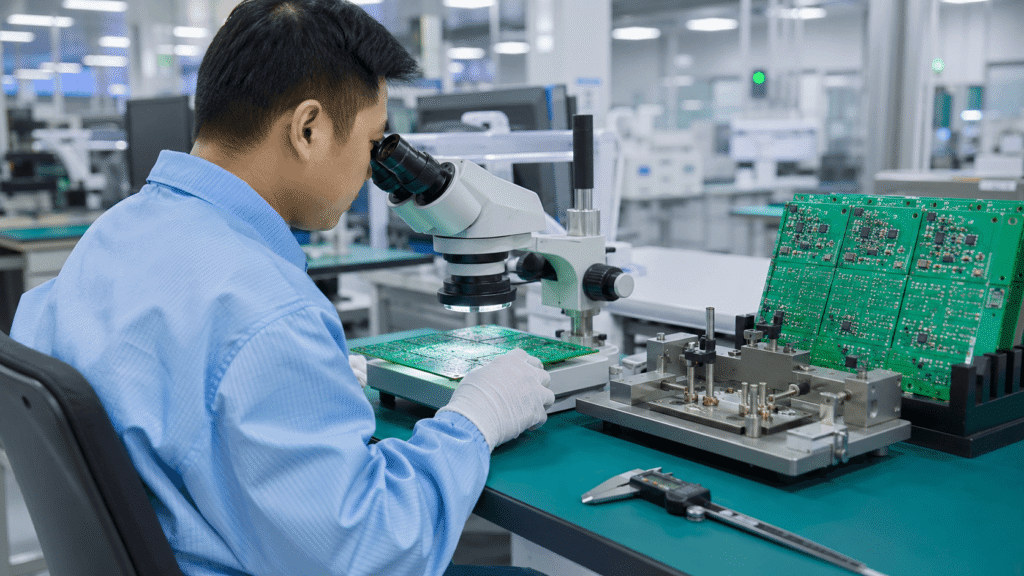
PCB manufacturing quality control is the process of checking and controlling each production step so finished circuit boards meet design, reliability, and customer requirements. Quality is not only confirmed at the end of production. It starts with file review and continues through material selection, drilling, plating, solder mask, surface finish, testing, and final inspection.
For buyers and engineers, strong quality control reduces the risk of open circuits, shorts, poor solderability, incorrect dimensions, weak plating, assembly problems, and field failures. EazyPCB supports PCB manufacturing projects with engineering review and quality control for prototypes and production orders.
1. File Review Before PCB Manufacturing
Quality control begins before production starts. Gerber layers, drill files, board outline, solder mask, silkscreen, stack-up notes, impedance requirements, and fabrication drawings should be checked for completeness and consistency.
A complete Gerber file checklist before PCB manufacturing helps prevent delays and mistakes. Missing files or unclear notes can lead to engineering questions, incorrect assumptions, or production risk.
2. DFM Review
DFM review checks whether the design can be manufactured reliably with the selected process. It covers trace width, spacing, hole size, annular ring, solder mask clearance, copper thickness, board outline, panelization, and special process requirements.
A practical PCB DFM checklist reduces quality risk before material is cut. This step is especially important for HDI boards, controlled impedance, heavy copper, fine-pitch, rigid-flex, and high-density PCB manufacturing.
3. Incoming Material Inspection
PCB quality depends on the materials used. Laminate, copper foil, prepreg, solder mask ink, and surface finish chemicals should match the project requirements. Material thickness, copper weight, TG value, and special substrate requirements need confirmation before production.
For critical products, material traceability and supplier control are also important. Standard FR-4, high-TG FR-4, aluminum substrate, Rogers, PTFE, and other materials should be selected according to operating environment and reliability needs.
4. Drilling and Hole Quality Control
Drilling affects vias, component holes, mounting holes, slots, and mechanical alignment. Poor drilling can cause hole size errors, breakout, burrs, smear, or plating defects.
Finished hole size, annular ring, aspect ratio, and via structure should be checked against the design and manufacturing capability. For critical dimensions, review the PCB manufacturing tolerances guide before production.
5. Copper Plating and Etching Control
Copper plating creates electrical connections through holes and vias. Etching defines the final trace pattern. Both steps must be controlled carefully because insufficient plating, over-etching, under-etching, or poor copper distribution can affect reliability.
Trace width, spacing, copper thickness, and via plating are important for current capacity and signal performance. High-current boards, heavy copper boards, and fine-line designs need more attention during PCB manufacturing.
6. Solder Mask and Surface Finish Inspection
Solder mask protects copper and helps prevent solder bridges. Quality control should check solder mask registration, pad openings, mask dams, via tenting, scratches, contamination, and color consistency.
Surface finish affects solderability and shelf life. HASL, ENIG, OSP, immersion silver, and immersion tin should be inspected according to the selected process. If the board will go through SMT assembly, solder mask and surface finish should be reviewed together.
7. Electrical Testing
Electrical testing checks whether the finished PCB has open circuits or short circuits. This is one of the most important final checks in PCB manufacturing, especially for production orders and dense multilayer boards.
Electrical test does not replace visual inspection or process control, but it helps confirm that the final circuit connections match the design data before shipment.
8. Dimensional and Visual Inspection
Finished boards should be inspected for board outline, thickness, hole size, solder mask, silkscreen, surface finish, scratches, contamination, warpage, and other visible defects. Dimensional checks are important when the PCB must fit into an enclosure or connector.
Inspection should match the board’s application. A simple prototype and a high-volume industrial product may need different inspection levels and documentation.
9. Quality Standards and Documentation
Industry standards help align expectations between customer and manufacturer. The IPC standards family is widely used in PCB manufacturing, and IPC-A-600 is commonly associated with acceptability of printed boards.
For quality management systems, ISO 9001:2015 is a widely recognized reference. For production projects, inspection reports, electrical test records, impedance reports, material certificates, or other documents may be requested when needed.
10. Quality Control and Lead Time
Quality checks require time, but they also help avoid larger delays caused by rework or failed assembly. Clear files, realistic tolerances, available materials, and confirmed testing requirements make the order easier to schedule.
If delivery speed matters, review our PCB manufacturing lead time guide. Quality control and lead time should be planned together instead of treated as separate concerns.
Build Reliable Boards with Controlled PCB Manufacturing
Reliable PCB manufacturing depends on controlled data, controlled materials, controlled processes, and controlled inspection. When each step is reviewed properly, finished boards are easier to assemble, test, and use in real products.
EazyPCB supports prototype and production PCB manufacturing with engineering review, inspection, and assembly support. If your project needs controlled quality, DFM review, special tolerances, or PCBA testing, you can contact our engineering team before production.
