
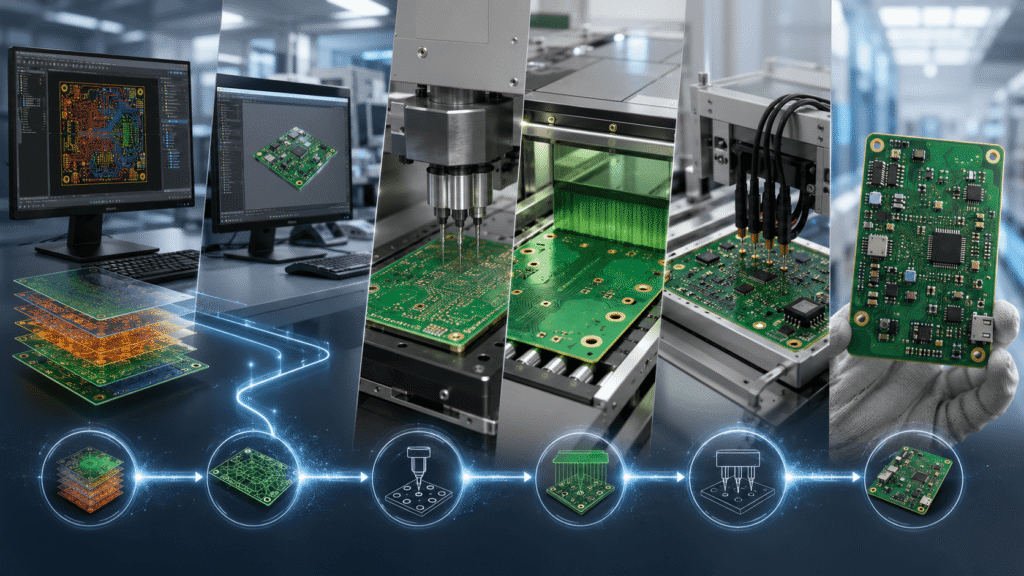
Prototype PCB manufacturing is the first practical step between a circuit design and a real electronic product. It helps engineers verify layout, materials, dimensions, solderability, assembly requirements, and functional performance before investing in larger production quantities.
A prototype is not only a small order. It is a technical validation stage in the full PCB manufacturing process. If the first sample is reviewed carefully, it can reduce redesign risk, shorten development time, and make the move to production smoother.
Why Prototype PCB Manufacturing Matters
Even when a PCB layout passes software design rules, the first physical board may reveal issues that are difficult to see on screen. Mounting holes, connector fit, trace width, solder mask, silkscreen readability, surface finish, panelization, and assembly handling can all affect the final result.
For early-stage projects, PCB prototyping allows the design team to test real boards before committing to volume production. This is especially useful for new products, engineering revisions, high-current designs, and compact electronics.
1. Prepare Complete Manufacturing Files
The prototype stage should start with complete files. Gerber layers, drill files, board outline, solder mask, silkscreen, paste layers, stack-up notes, impedance requirements, and fabrication drawings should match the intended design.
Before ordering, review the Gerber file checklist before PCB manufacturing. Clear files reduce engineering questions and help the supplier start CAM review faster.
2. Use DFM Review Before Building Samples
DFM review checks whether the design can be manufactured reliably. In prototype PCB manufacturing, DFM is important because early mistakes may be repeated in later production if they are not found in time.
Use a PCB DFM checklist to review trace width, spacing, drill holes, annular rings, solder mask clearance, copper thickness, board outline, and special process notes.
3. Keep the Prototype Close to the Final Product
A prototype should be close enough to the final product to provide useful feedback. If the production board will use a specific material, thickness, surface finish, copper weight, or stack-up, the prototype should match those requirements when possible.
If the prototype uses simplified specifications only to save cost, the team should understand which results may not represent the final production board.
4. Check Materials and Stack-Up Early
Material and stack-up choices affect signal performance, thermal behavior, mechanical fit, and reliability. Standard FR-4 works for many prototypes, but high-TG FR-4, aluminum substrate, Rogers, PTFE, or other special materials may be needed for specific products.
For complex designs, review the supplier’s PCB manufacturing capabilities before ordering samples. This avoids selecting a prototype specification that cannot scale to production.
5. Consider Prototype Cost and Lead Time
Prototype PCB manufacturing usually has a higher unit cost than production because setup, engineering review, CAM work, and production preparation are spread across a small quantity. However, a well-planned prototype can save cost by catching problems early.
Review our guides on PCB manufacturing cost factors and PCB manufacturing lead time if you need to balance price and speed.
6. Test the Prototype Carefully
After receiving prototype boards, inspect both physical quality and electrical performance. Check board outline, hole size, solder mask, surface finish, warpage, silkscreen, connector fit, and any critical dimensions.
Electrical testing, functional testing, and assembly testing help confirm whether the design is ready for the next stage. Our PCB manufacturing quality control guide explains common inspection steps.
7. Prototype PCB and SMT Assembly
If the project will become a complete PCBA, the prototype should also verify assembly requirements. BOM quality, component availability, paste layer, stencil design, fiducials, panelization, test points, and packaging can all affect SMT assembly.
It is better to review PCB fabrication and assembly together instead of treating them as separate tasks. A board that is easy to manufacture may still create assembly problems if placement, solder mask, or panelization is not planned correctly.
8. Document Prototype Feedback
Prototype feedback should be recorded clearly. If the board needs changes, note whether the issue is electrical, mechanical, thermal, manufacturing-related, assembly-related, or supplier communication-related.
This record helps the team decide whether the design is ready for a second prototype, small batch production, or full production release.
9. Standards and Quality Expectations
Industry standards help align expectations before prototype and production. The IPC standards family is widely used in PCB manufacturing, and IPC-A-600 is commonly associated with acceptability of printed boards.
For quality management systems, ISO 9001:2015 is also a recognized reference. For critical products, define acceptance criteria and inspection needs before ordering prototypes.
10. Moving from Prototype to Production
Before moving to production, confirm that the prototype design, material, stack-up, surface finish, tolerances, test results, and assembly process are stable. If the design changed after prototype testing, the production files should be reviewed again.
For larger builds, production planning may include panel utilization, batch consistency, quality documentation, packaging, and delivery schedule. EazyPCB supports both prototype PCB manufacturing and volume production.
Build Better Products with Better Prototypes
A prototype PCB is more than a sample board. It is a decision point that helps confirm whether the design is manufacturable, assembleable, testable, and ready for the next stage.
If you are preparing a new prototype, you can use the PCB price calculator for early estimation or contact EazyPCB with your Gerber files, BOM, quantity, and target schedule. Our team can help review manufacturability, cost, lead time, and production readiness before you order.
