
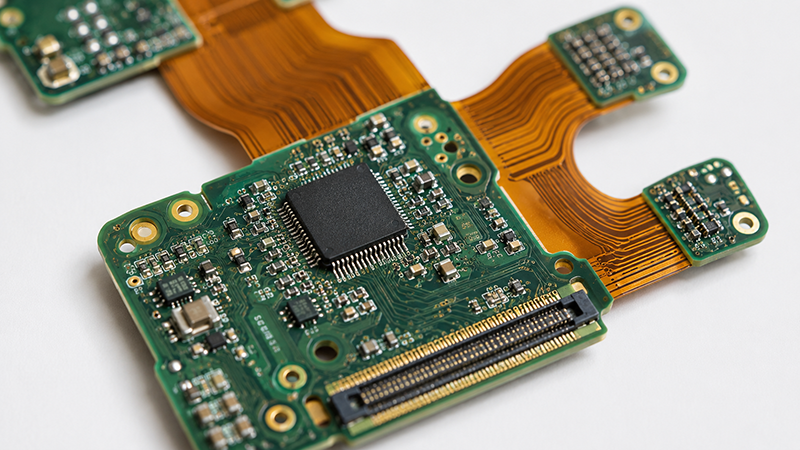
Rigid-flex PCB technology combines rigid circuit board sections with flexible circuit areas in one integrated structure. Instead of connecting separate boards with cables or connectors, a rigid-flex design allows the circuit to bend, fold, or fit into a compact three-dimensional product space.
This makes rigid-flex PCBs useful in products where size, weight, reliability, and assembly efficiency matter. Common applications include medical devices, wearable electronics, cameras, sensors, aerospace systems, industrial modules, and compact consumer products.
What Is a Rigid-Flex PCB?
A rigid-flex PCB includes both rigid board areas and flexible polyimide-based circuit areas. Components are usually mounted on the rigid sections, while the flexible sections act as built-in interconnects between different parts of the product.
Compared with a cable-and-connector approach, rigid-flex can reduce assembly steps, save space, improve vibration resistance, and increase design freedom.
When Should You Use Rigid-Flex?
- The product has limited internal space.
- The PCB must fold or bend during installation.
- Multiple rigid boards need to be connected reliably.
- Cables and connectors add too much size, weight, or failure risk.
- The product must withstand vibration, movement, or repeated handling.
- The design targets medical, wearable, aerospace, or compact industrial applications.
Benefits of Rigid-Flex PCB
Rigid-flex designs can reduce the number of connectors, cables, and solder joints. Fewer interconnects often mean fewer potential failure points. They can also reduce assembly time because the board structure already includes the flexible connection.
Another advantage is mechanical freedom. The flexible area can route signals around corners, through narrow spaces, or between stacked product sections. This is valuable when designing compact enclosures.
Key Design Rules for Bend Areas
The flexible section must be designed carefully. Avoid placing vias, pads, or sharp trace corners in the bend area whenever possible. Copper traces should follow smooth curves instead of sharp angles, and the bend radius should match the material and copper thickness.
Repeated bending requires more conservative rules than one-time folding during assembly. If the flex area will move during product use, discuss dynamic bending requirements with the manufacturer early.
Material and Stack-Up Planning
Rigid-flex PCBs often use FR-4 for rigid areas and polyimide for flexible areas. Adhesive, coverlay, copper thickness, stiffeners, and layer transitions all affect reliability and manufacturability.
Stack-up planning should begin before layout. The number of rigid layers, flex layers, bend regions, and transition zones must be clearly defined so the manufacturer can confirm feasibility.
Common Rigid-Flex Design Mistakes
- Using too small a bend radius.
- Routing sharp trace corners through the flex area.
- Placing vias or pads in the bend region.
- Ignoring stiffener requirements.
- Leaving the transition between rigid and flex areas unclear.
- Treating dynamic flex requirements the same as one-time bending.
Cost Considerations
Rigid-flex PCBs usually cost more than standard rigid boards because they require more complex materials, stack-up control, lamination, and inspection. However, they may reduce total product cost by eliminating cables, connectors, manual assembly steps, and reliability problems.
The right way to evaluate rigid-flex is to compare the full product-level value, not only the PCB unit price.
Work with Your PCB Manufacturer Early
Rigid-flex design requires close coordination between mechanical design, electrical layout, and manufacturing capability. Early review of bend radius, material choice, stack-up, stiffeners, and panelization can prevent redesign work later.
EazyPCB supports prototype and production PCB manufacturing for advanced board structures. If your product needs compact routing, flexible interconnects, or a rigid-flex architecture, our team can help review key manufacturing requirements before production.
