
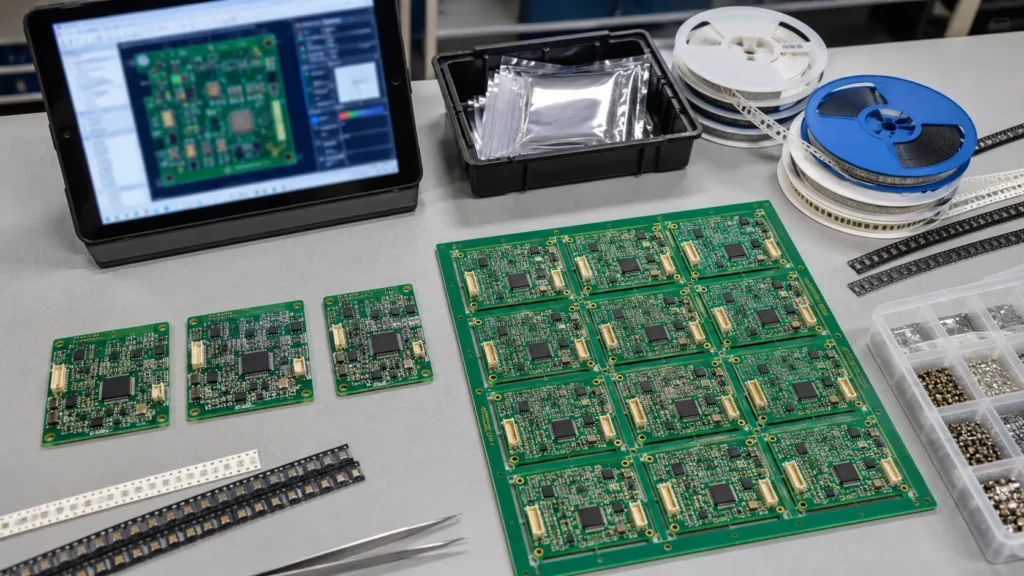
Low-volume PCB manufacturing is the stage between prototype validation and full volume production. It is often used for pilot runs, engineering validation, market testing, product revisions, and early customer shipments. For many electronic products, this stage is where the design becomes more stable and production risks become clearer.
A small batch order is not only a larger prototype. It should be treated as a controlled PCB manufacturing step with proper file review, material confirmation, component planning, assembly preparation, inspection, and communication. When managed well, low-volume production can reduce the risk of quality problems before the project scales.
Why Low-Volume PCB Manufacturing Matters
Prototype boards help confirm that a circuit can work. Low-volume PCB manufacturing helps confirm whether the board can be built repeatedly with stable quality, reasonable cost, and predictable lead time. This is especially important for IoT devices, industrial controls, smart home products, medical electronics prototypes, and new consumer electronics.
Before moving from PCB prototyping to small batch production, the design team should review whether the prototype specification truly represents the final product. Material, copper thickness, surface finish, stack-up, panelization, and assembly process should be close to the intended production version.
1. Freeze the Important Design Parameters
Low-volume production should not start while every detail is still changing. Minor revisions are normal, but key parameters should be confirmed: board dimensions, layer count, material, copper thickness, surface finish, solder mask, silkscreen, connectors, and mounting holes.
A clear PCB DFM checklist can help identify issues before production. If these details are not checked early, the same problem may appear across every board in the batch.
2. Confirm Materials and Fabrication Capability
For small batch PCB production, material choice should match the real application. Standard FR-4 is common, but high-TG FR-4, aluminum substrate, controlled impedance stack-ups, or thicker copper may be needed depending on thermal, mechanical, or electrical requirements.
Before ordering, review the manufacturer’s PCB manufacturing capabilities and the full PCB manufacturing process. This helps confirm whether the selected specification can be produced consistently, not only once.
3. Prepare BOM and Components Earlier
Many low-volume PCB manufacturing delays are caused by components, not bare boards. A missing connector, long lead-time IC, substitute component, or unclear part number can delay SMT assembly even when the PCB is ready.
For assembled boards, prepare the BOM, pick-and-place file, polarity notes, package information, and approved alternatives before SMT assembly. Component sourcing should be checked early, especially for wireless modules, connectors, sensors, power ICs, and automotive or industrial-grade parts.
4. Use Panelization for Efficiency
Small batch PCB production can benefit from proper panelization. Good panel design improves handling, solder paste printing, pick-and-place accuracy, reflow stability, and depaneling efficiency.
Panelization should consider board shape, tooling rails, fiducial marks, breakaway tabs, V-score, mouse bites, and component clearance. When the panel is planned correctly, the batch is easier to assemble and inspect.
5. Plan Inspection Before Production Starts
Inspection should not be an afterthought. AOI, electrical test, visual inspection, solderability review, dimensional checks, and functional testing may be needed depending on the board. For PCBA projects, test points and programming connectors should be included in the design when possible.
A defined PCB manufacturing quality control plan helps both the customer and supplier understand what will be checked. Standards such as IPC standards and IPC-A-600 can also help define quality expectations.
6. Control Cost Without Removing Key Safeguards
Low-volume PCB manufacturing usually has a higher unit cost than volume production because setup, engineering, stencil, sourcing, and inspection costs are spread across fewer pieces. However, reducing the wrong process can create more cost later through rework or field failure.
Instead of removing important inspections, review the true PCB manufacturing cost factors. Quantity, panel utilization, material selection, surface finish, component availability, assembly complexity, and test requirements all affect price.
7. Manage Lead Time Realistically
Small batch orders can move quickly when files and components are ready, but lead time depends on more than board fabrication. CAM review, material preparation, component sourcing, stencil production, SMT assembly, inspection, and shipping all need time.
Before placing the order, check the likely PCB manufacturing lead time. If the project has a strict launch date, it is better to confirm risk items early rather than wait until production has already started.
8. Use Low-Volume Runs to Prepare for Volume Production
A low-volume run should generate useful feedback. Record assembly yield, component issues, test failures, cosmetic concerns, packaging needs, and customer feedback. These notes help improve the design before volume production.
If the small batch is stable, the same files, BOM, panelization, test method, and quality requirements can become the foundation for larger production. If problems appear, this stage gives the team a chance to fix them before the order quantity increases.
Final Thoughts
Low-volume PCB manufacturing is a practical bridge between engineering and real production. It helps companies test whether a PCB design can be built repeatedly, assembled reliably, inspected clearly, and delivered on schedule.
EazyPCB supports PCB fabrication, assembly, small batch production, quality control, and project review. If you are planning a low-volume PCB or PCBA order, you can use the PCB price calculator or contact us to review your project requirements.
