
Introduction
In the world of electronics manufacturing, the terms PCB and PCBA are often used interchangeably, but they represent two very different stages of production. For buyers and product managers, understanding these differences is crucial for budgeting, timelines, and supply chain management. This guide will break down the technicalities into simple business terms.
Key Definitions
What is a PCB?
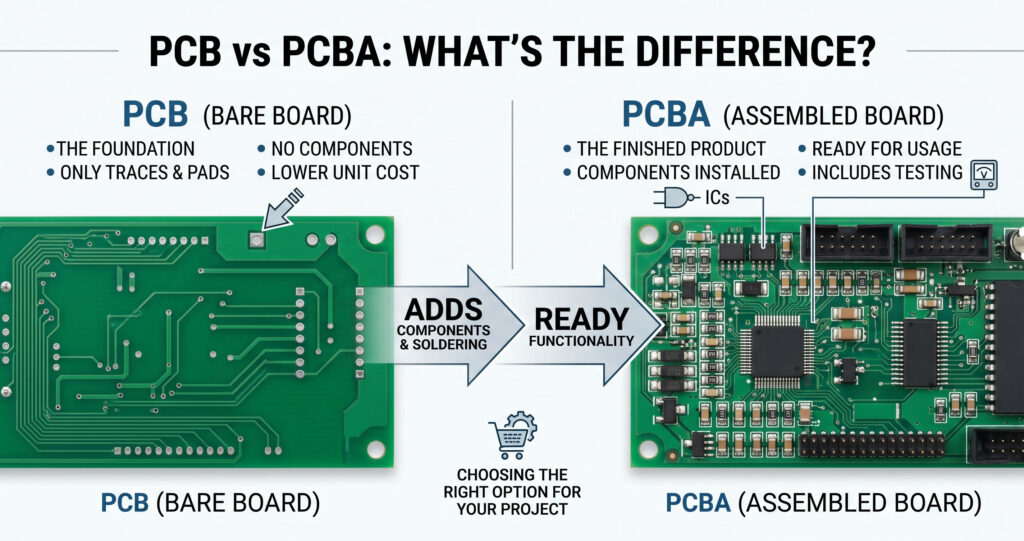
A Printed Circuit Board (PCB) is the “green board” you see inside gadgets. It is the bare foundation made of insulating material and copper traces. At this stage, it has no electronic components attached. It acts as the skeleton that provides the path for electricity to flow.
What is a PCBA?
PCBA stands for Printed Circuit Board Assembly. This is the finished product. It refers to a PCB that has undergone soldering and has all necessary components (resistors, capacitors, chips) installed. If the PCB is the skeleton, the PCBA is the full body with muscles and brains, ready to perform a task.
Clear Comparison Table
| Feature | PCB (Bare Board) | PCBA (Assembled Board) |
| Components | None | Full (ICs, Resistors, etc.) |
| Function | Provides electrical pathways | Performs specific logic/tasks |
| Manufacturing | Etching, Drilling, Plating | Solder Paste, SMT, Reflow |
| Cost | Lower (Material + Design) | Higher (Material + Components + Labor) |
| Lead Time | Shorter | Longer (Sourcing components takes time) |
Pros & Cons
PCB (Bare Board)
-
Pros: Lower initial cost per unit; easier to store in bulk; allows you to source components separately if you have your own assembly line.
-
Cons: Useless on its own; requires secondary manufacturing steps; higher risk of component compatibility issues later.
PCBA (Assembled Board)
-
Pros: Ready to be installed into your device; simplified supply chain (one vendor); quality is tested on the final functional level.
-
Cons: Higher upfront cost; longer lead times due to component sourcing; higher loss if a board fails during assembly.
How to Choose?
The choice depends on your company’s capabilities and project stage:
-
Choose PCB if: You have an in-house assembly team, you are an electronics hobbyist, or you already own a large stock of specialized components.
-
Choose PCBA if: You want a “turnkey” solution. Most modern businesses prefer PCBA because it reduces the number of vendors to manage and ensures the final product is tested for functionality before shipping.
Our Recommendation
For most electronics buyers, especially in foreign trade, we recommend PCBA. While the unit price is higher, it significantly reduces your overhead costs. Managing a single PCBA supplier is more efficient than managing one PCB manufacturer and five different component vendors. It also shifts the responsibility of functional testing to the manufacturer, ensuring higher reliability.
Conclusion
Understanding the difference between PCB and PCBA is the first step toward a successful hardware project. A PCB is the essential foundation, but a PCBA is the functional heart of your product. By choosing the right service based on your assembly capabilities, you can optimize your costs and get your product to market faster.
