
Introduction
The automotive industry is currently experiencing a tectonic shift, moving away
from purely mechanical engineering toward a future defined by software and
electronics. Modern vehicles are essentially complex networks of high-performance
computers. At the core of every smart sensor, safety feature, and electric powertrain
lies the Printed Circuit Board Assembly (PCBA).
For electronics buyers and automotive engineers, the reliability of a PCBA is no
longer just a technical specification—it is a safety-critical requirement. As we move
toward Level 5 autonomy and complete electrification, the demand for
sophisticated, multi-layer, and high-reliability automotive PCBAs is skyrocketing.
This article explores the top six applications driving this demand and the rigorous
standards they must meet.
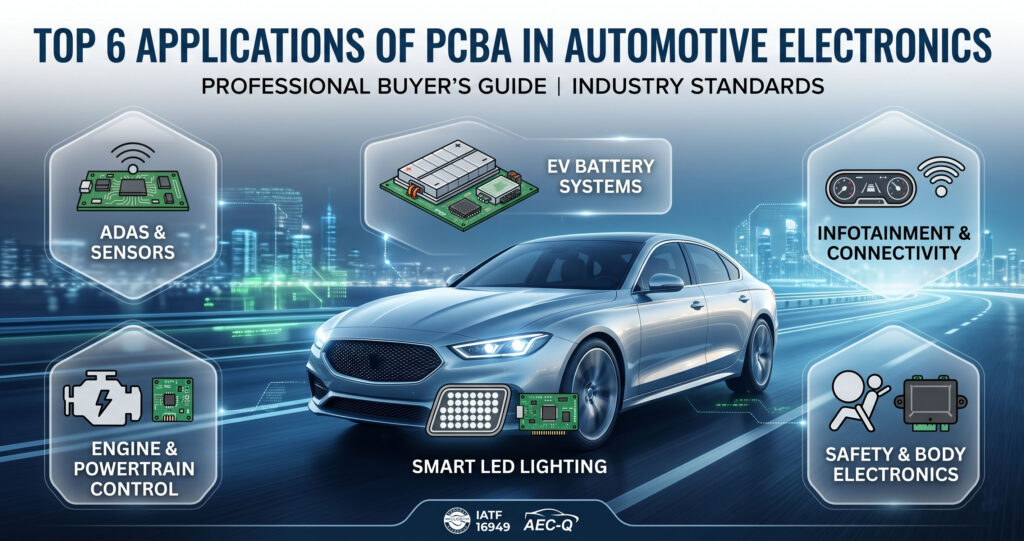
1. Advanced Driver Assistance Systems (ADAS)
ADAS represents the pinnacle of real-time computing in vehicles. Systems such as
lane-keeping assistance, adaptive cruise control, and pedestrian detection rely on a
constant stream of data from cameras, LiDAR, and radar sensors. The PCBA in an
ADAS module must process this data with near-zero latency.
High-Speed Signal Integrity
Because these systems operate on high-frequency signals, the PCBAs often utilize
specialized laminates and high-speed digital design techniques. Reliability is
paramount; a failure in an ADAS PCBA could lead to system malfunction in a critical
moment. These assemblies must withstand the “harsh environment” of a vehicle—
vibration, humidity, and rapid temperature changes—without compromising signal
integrity.
2. EV Battery Management Systems (BMS)
In the era of New Energy Vehicles (NEVs), the Battery Management System is the
most vital electronic component. It ensures that the lithium-ion battery pack
operates within its safe functional limits. A BMS PCBA monitors cell voltage,
temperature, and state of charge (SoC).
Managing Power and Heat
Efficiency in electric vehicles is often measured by the power output equation P = V
× I. Handling high currents requires PCBAs with heavy copper traces to minimize
resistance and heat generation. Furthermore, these boards must be designed with
advanced thermal vias to dissipate heat, preventing “thermal runaway,” which is the
leading cause of battery fires.
3. In-Vehicle Infotainment (IVI) & Connectivity
Modern consumers demand a seamless digital experience. In-vehicle infotainment
systems have evolved from simple radios into integrated hubs managing GPS, 5G
connectivity, and smartphone integration. PCBA applications here focus on
processing power and multi-functional connectivity.
With the rise of “Vehicle-to-Everything” (V2X) communication, these PCBAs must
manage complex wireless protocols. Designers often use High-Density Interconnect
(HDI) technology to fit powerful processors and memory modules into the compact
spaces behind the dashboard, all while ensuring robust EMI/EMC shielding to
protect the car’s more sensitive safety electronics.
4. Powertrain and Engine Control Units (ECU)
Whether in a traditional internal combustion engine (ICE) or a hybrid, the ECU is the
“brain” that optimizes performance. It adjusts fuel injection, ignition timing, and
turbocharger pressure in real-time. The PCBA for an ECU is typically located in the
engine bay, subjecting it to some of the most extreme conditions in the car.
These assemblies require specialized conformal coatings and high-temperature
soldering alloys. The boards are often built on ceramic or heavy-duty FR4 substrates
to survive constant exposure to heat cycles, oils, and automotive fluids over a
service life that often exceeds 15 years.
5. Automotive LED Lighting Systems
Lighting has transitioned from a simple utility to a sophisticated electronic system.
Modern matrix LED headlights can adjust their beams to avoid blinding oncoming
traffic while keeping the road illuminated. This logic is controlled by dedicated
lighting PCBAs.
The primary technical challenge for lighting PCBAs is thermal management. LEDs
are highly efficient but sensitive to heat. To solve this, manufacturers often use
Metal Core PCBs (MCPCBs) with an aluminum base. The aluminum substrate acts as
a built-in heat sink, drawing heat away from the LEDs to maintain consistent
brightness and prevent premature failure.
6. Safety and Body Electronics
Body electronics encompass the wide array of “comfort and convenience” features,
such as electronic power steering (EPS), airbag deployment modules, and automatic
climate control. While individual components may seem small, the Body Control
Module (BCM) acts as a central PCBA hub for these functions.
Airbag deployment PCBAs, in particular, must be extremely robust. They utilize
redundant circuits to ensure that the system triggers only when intended—and
always when needed. These boards undergo 100% functional testing and X-ray
inspection to ensure that every solder joint is flawless before it ever leaves the
factory.
Key Requirements for Automotive PCBA
To be considered “Automotive Grade,” a PCBA must adhere to a set of standards
that are far stricter than those for consumer electronics:
- IATF 16949 Certification: This is the fundamental quality management system
for the automotive supply chain. - Environmental Resistance: Components must operate reliably across a wide
temperature range, typically from -40°C to +125°C. - IPC-A-610 Class 3: Most automotive electronics are manufactured to Class 3
standards, which represent the highest level of reliability for high-performance
electronic products. - Vibration and Shock Testing: Automotive PCBAs must pass rigorous
mechanical stress tests to ensure they won’t crack or fail on rough roads.
Conclusion
As we look toward a future of autonomous driving and smart mobility, the
importance of PCBA in the automotive sector will only grow. From the
critical safety logic of ADAS to the power management of EV batteries, these
circuit assemblies are the foundation of modern transportation. For buyers,
the goal is clear: find a manufacturing partner who combines technical
precision with a deep understanding of automotive-grade reliability.
