| Category | Features | Capability | Description |
|---|---|---|---|
|
Layer Count
|
1 layer,2 layers
|
The number of copper layers in the FPC
|
Rigid-flex PCBs are not yet supported.
|
|
FPC Stack-Up
|
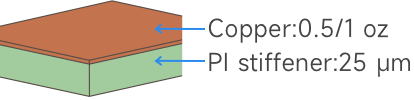
Single-Sided
|
FPC with copper and coverlay on the same one side only. Inner PI thickness: 25 μm
|
|
|
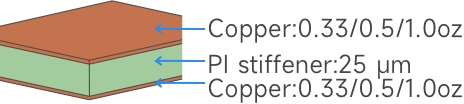
Double-Sided
|
FPC with copper on both sides. Inner PI thickness: 25 μm
|
|
|
|
Dimensions
|
Maximum Dimensions
|
Regular: 234 × 490 mm
|
Absolute limit of 250 × 500 mm allowed with mandatory handling edges – confirm with customer support before ordering
|
|
Minimum Dimensions
|
No limit, but FPCs whose dimension is smaller than 20 × 20 mm are best panelised
|
||
|
FPC Finished Thickness
|
Single-sided: 0.07 / 0.11 mm Double-sided: 0.11 / 0.12 / 0.2 mm |
The thickness of the finished FPC excluding any stiffeners(If the measured area has no copper or coverlay, the finished thickness will be reduced.)
|
|
|
Outer Layer Copper Weight
|
Single-sided: 18 μm (0.5 oz), 35 μm (1 oz) Double-sided: 12 μm (0.33 oz), 18 μm (0.5 oz), 35 μm (1 oz) |
The thickness of copper on the FPC
|
|
|
Type of Process
|
Dry film process with LDI (laser direct image) exposure technology
|
LDI provides higher accuracy than traditional LED exposure. The machines also support automatic alignment based on board size to eliminate pad offset issues.
|
|
|
Surface Finish
|
ENIG. Thickness: 1u" / 2u"
|
ENIG deposits a nickel-gold coating on exposed pads to prevent oxidation.
|
|
|
Thickness with Stiffener
|
Thickness with Stiffener = FPC Thickness + Stiffener Thickness
|
||
|
FPC Thickness Tolerance
|
±0.05 mm
|
Additional tolerance exists for stiffeners. Thicker stiffeners have larger tolerances.
|
|
|
Holes
|
Hole Diameter
|
0.15-6.5 mm
|
The recommended maximum diameter for PTHs is 5 mm, if bigger may cause risks to production
|
|
Diameter Tolerance
|
±0.08 mm
|
Example: A 1.00 mm designed diameter is allowed to yield any physical diameter between 0.92-1.08 mm.
|
|
|
Minimum Plated Slot
|
0.50 mm
|

|
|
|
Minimum Non-Plated Slot
|
Not limited
|
At least 0.2 mm copper clearance is required around non-plated slots.
|
|
|
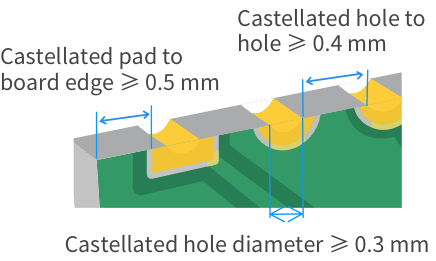
Castellated holes are plated half-holes on the edge of an FPC. Most often used for press-soldered connectors. ① Castellated hole diameter: ≥ 0.3 mm ② Castellated hole to board edge: ≥ 0.5 mm ③ Castellated hole to hole: ≥ 0.4 mm |
|
||
|
Min. Via hole size/diameter
|
0.15 mm (Via hole size)/ 0.35 mm (Via diameter) ① Annular ring: 0.1 mm minimum, 0.125 mm recommended ② Recommended via size: 0.3 mm inner, 0.55 mm outer |

|
|
|
Traces
|
Annular Ring for PTH
|
≥ 0.25 mm recommended, absolute limit: 0.18 mm
|

|
|
Minimum Trace Width/Spacing (1 oz)
|
① 12 μm (0.33 oz) copper: 3/3 mil (absolute limit 2/2 mil – avoid if possible) ② 18 μm (0.5 oz) copper: 3.5/3.5 mil ③ 35 μm (1 oz) copper: 4/4 mil These are regular capabilities. Contact customer support for custom capability requirements. |

|
|
|
Trace Width Tolerance
|
±20%
|
Example: A 0.10 mm designed trace width is allowed to yield any physical width between 0.08-0.12 mm.
|
|
|
Pad-to-Trace Clearance
|
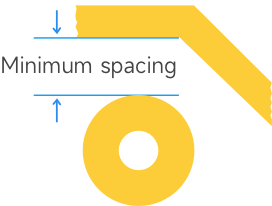
① Via ring to trace: ≥ 0.1 mm (more whenever possible) ② Exposed pad to trace:≥ 0.15 mm (more whenever possible) |
|
|
|
NPTH to Copper Clearance
|
≥ 0.20 mm
|
The clearance from an NPTH to traces, pads, and copper pours
|
|
|
BGA
|
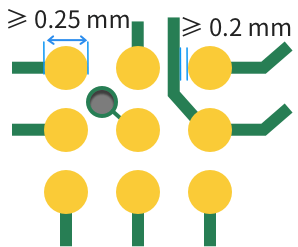
① BGA pad diameter: ≥ 0.25 mm ② BGA pad to trace clearance: ≥ 0.2 mm |
|
|
|
Coverlay/ Soldermask |
Coverlay Color
|
Yellow / Black / White
|
Yellow is recommended
|
|
Coverlay Opening
|
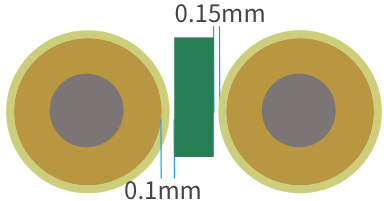
Coverlay expansion (one-sided): 0.1 mm Coverlay opening to trace clearance: ≥ 0.15 mm (more whenever possible) |
|
|
|
Via covering
|
Recommended to keep coverlay over vias
|
||
|
Coverlay Thickness
|
① PI: 12.5 μm, glue: 15 μm (on 12/18 μm copper) ② PI: 25 μm, glue: 25 μm (on 35 μm copper) |

|
|
|
Minimum solder bridge width
|
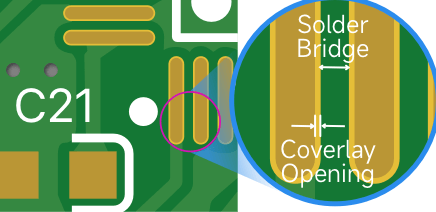
0.5 mm minimum, i.e. solder bridge narrower than 0.5 mm will be removed. Contact customer support for any non-standard requirements.
|
|
|
|
Silkscreen
|
Character Height
|
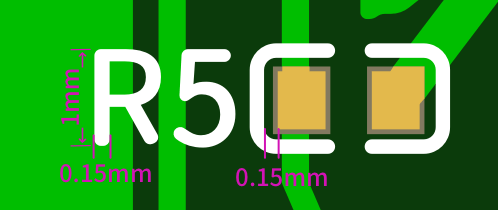
≥ 1mm (More in case of complex patterns or knock-out text)
|
|
|
Character Line Width
|
≥ 0.15mm (Narrower lines do not print well)
|
||
|
Character to Pad Clearance
|
≥ 0.15mm (Any silkscreen closer to a pad than this will be clipped)
|
||
|
FPC Outline
|
Laser Outline
|
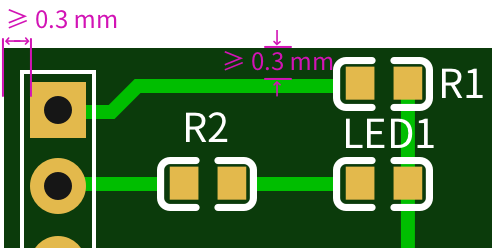
① Copper to board edge ≥ 0.3mm ② Copper to slots ≥ 0.3mm ③ Outline tolerance: ±0.1 mm (±0.05 mm upon request) |
|
|
Gold Finger Pad to Board Edge Clearance
|
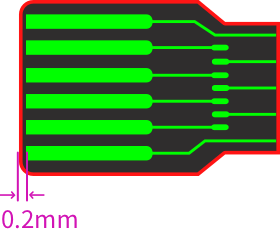
0.2 mm. Gold fingers will be cut back if exceeding this clearance to avoid damage during laser cutting the outline. Castellated pads are exempt from this clearance.
|
|
|
|
Panels (See FPC Panel Design Guide)
|
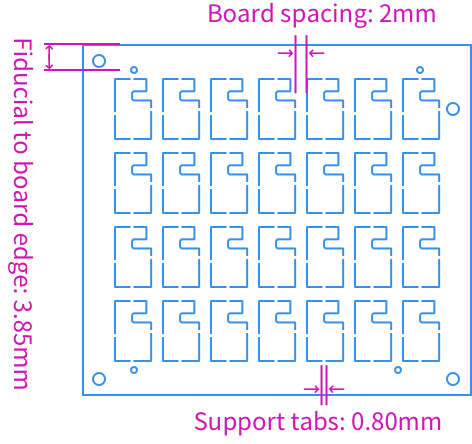
① Spacing between boards is commonly 2 mm. For boards with metal stiffeners use 3 mm instead. ② Handling edges of width 5 mm required on all four sides. Copper pour is required on these edges, with 1 mm clearance around fiducials and 0.5 mm clearance around tooling holes. ③ Fiducials: 1 mm; tooling holes: 2 mm; Fiducial centre to board edge: 3.85 mm. Add four fiducials with one offset by 5 mm or more to aid orientation. ④ Support tab width: 0.7-1.0 mm ⑤ Maximum panel size: 234 × 490 mm |
|
|
|
Stiffeners (Detailed Introduction)
|
PI Stiffener
|
Thickness options: 0.1 mm, 0.15 mm, 0.20 mm, 0.225 mm, 0.25 mm
|
PI stiffeners are most often used with gold finger connectors. For example if the connector needs to be 0.3 mm thick on a 0.11 mm FPC, a 0.225 mm stiffener thickness is most suitable.
|
|
FR4 Stiffener
|
Thickness options: 0.1 mm, 0.2 mm
|
FR4 is usually only used on low-end products because it is prone to chipping. Avoid if possible.
|
|
|
Stainless Steel Stiffener
|
Thickness options: 0.1 mm, 0.2 mm, 0.3 mm
|
Steel stiffeners cost more but have excellent flatness and do not easily deform. This makes them good as support under SMD components. Note that since steel is slightly magnetic it should not be used with hall effect sensors or similar components.
|
|
|
3M Tape
|
3M9077 (0.05 mm thick; heat-resistant) 3M468 (0.13 mm thick; not heat-resistant) |
Usually used to secure FPCs after assembly
|
|
|
EM Shielding Film
|
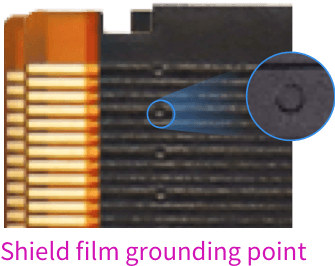
18 μm thick, black. Helps lower EMC. The recommended practice is to add soldermask openings over edge guard rails to electrically connect them to the shield films.
|
|
|
|
Design Considerations
|
Impedance Calculation
|
Core polyimide εr: 3.3 Coverlay εr: 2.9 Core polyimide thickness: 25 μm |
Impedance measurement and control are not yet supported. Traces are only controlled for width and the customer is responsible for choosing trace widths to achieve their impedance requirements.
|
|
Other FPC Software
|
For compatibility on the layer types, include the outlines of the coverlay openings, stiffener outlines, and any other features in the design files. These should be included as separate layers in the Gerber output.
|
||
|
Other Design Constraints
|
Same requirements as rigid PCBs in terms of holes, traces, clearances, and silkscreen.
|
||
|
Gerber File Naming Convention
|
We recommend using standard Gerber file extensions as listed in the design guidelines. If you use non-standard file extensions we will still process your order but the risk of mistakes in layer stackup increases and processing time may be longer.
|